Highlights
- The Hyundai Bayon India launch is set for 26 October 2026, with a 1.5-litre MPi petrol engine rated at 115 PS and 143.8 Nm.
- It matters most to buyers who have already put down ₹11,000 without seeing a price, and to every compact SUV rival that cannot match a 23-feature Level 2 ADAS suite.
- Price is the last unknown. Wait for the variant list on 26 October before you lock your booking to a specific trim.
Follow TrendPulse360 for real-time EV news, reviews, and buying guides.
In this article
- Confirmed specifications
- What Hyundai has already told us
- Design
- Engine and gearboxes
- Safety and ADAS
- Interior and technology
- Price, booking and delivery
- Who it competes with
- What this means for buyers
- FAQs
Confirmed specifications
| Spec | Figure | Notes |
|---|---|---|
| Launch date | 26 October 2026 | Confirmed by HMIL |
| Engine | 1.5L MPi four-cylinder petrol | Naturally aspirated |
| Max power | 84.4 kW (115 PS) | Official figure |
| Max torque | 143.8 Nm (14.7 kgm) | Official figure |
| Transmission | 6-speed manual or iVT | Three drive modes |
| Platform | Global K Enhanced Platform | 69% high-strength steel |
| Airbags | Six, standard | Across all variants |
| ADAS | SmartSense Level 2 Pro | 23 features, 3 radars |
| Displays | Dual 12.3-inch curved | 62.5 cm panoramic |
| Booking amount | ₹11,000 | Online or dealership |
| Ex-showroom price | To be confirmed — check the manufacturer’s official announcement for the latest figures. | Due 26 October |
| Variant line-up | To be confirmed — check the manufacturer’s official announcement for the latest figures. | Not yet disclosed |
| Dimensions | To be confirmed — check the manufacturer’s official announcement for the latest figures. | Not yet disclosed |
What Hyundai has already told us
Hyundai Motor India Limited launches the Bayon on 26 October 2026. Unusually for an Indian launch, very little has been held back for the day itself.
The engine is a 1.5-litre MPi four-cylinder petrol rated at 84.4 kW (115 PS) and 143.8 Nm (14.7 kgm). Buyers pick between a 6-speed manual and Hyundai’s Intelligent Variable Transmission. Nothing Hyundai has published mentions a turbo, a diesel or a hybrid.
Bookings opened on 23 September at ₹11,000, taken on hyundai.co.in or at any authorised dealership. Deliveries start in the festive season, with exact dates promised at launch.
So what is actually missing? Price. Variants. Dimensions. Hyundai has published none of the three.
Design: Art of Steel, and a new lighting signature
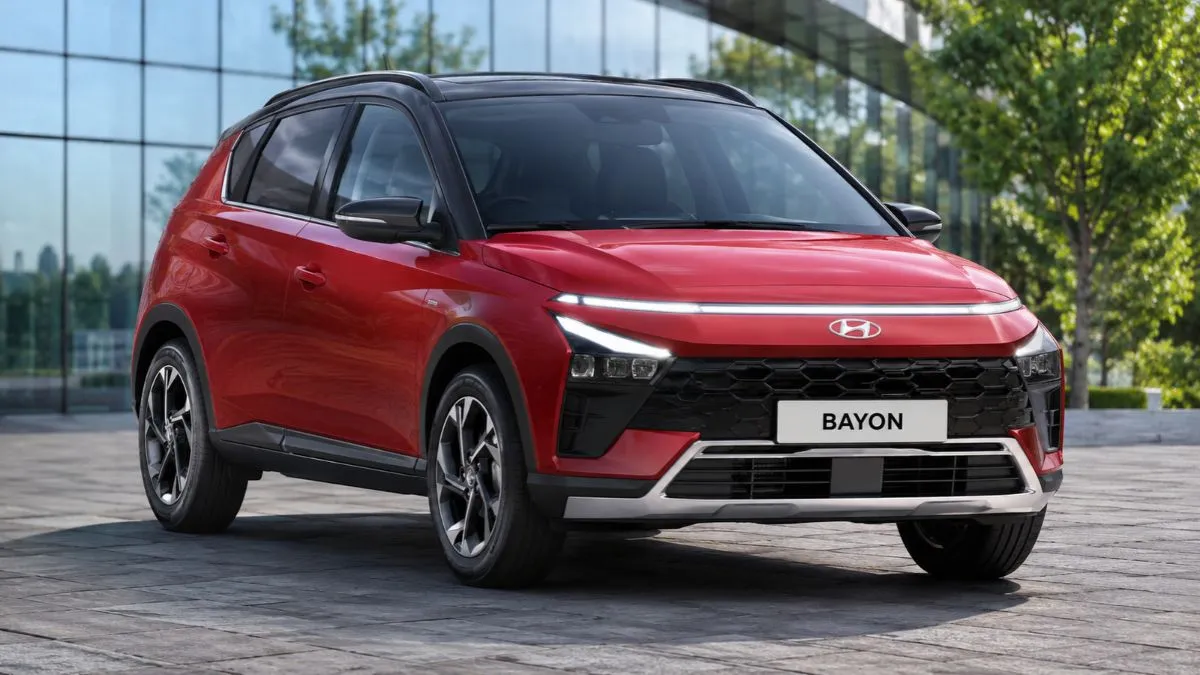
Hyundai calls the Bayon an “Intelligent Utility Vehicle”, which is brand language rather than a segment. The styling comes from the company’s Art of Steel design direction.
Its own sketches confirm an H-Edge lighting signature at the front, pronounced fenders, a sculpted hood and what Hyundai describes as robust lower body elements. The brief, in the company’s words, is “a high-tech interior within a tough exterior.”
Wheel sizes, tail lamp detail and the colour palette remain unpublished. Sketches flatter, so treat the proportions as indicative until the car is on a stand.
Engine and gearboxes: 115 PS, with a catch
Based on manufacturer data, this is a naturally aspirated engine rather than a turbo. That places 115 PS and 143.8 Nm in the familiar band for a mid-size petrol in India, and it usually means torque builds higher in the rev range than a turbo-petrol rival delivers it.
Both gearboxes get Eco, Normal and Sport modes, chosen from a steering-mounted Drive Mode button. Paddle shifters are confirmed.
Now the part worth reading twice. Dash Boost Mode and Sporty Drive Tech, the two features Hyundai is pushing hardest as the performance story, come only with the iVT. Hyundai has not explained what either one changes.
Safety: six airbags standard, and a long ADAS list
This is where Hyundai has been most generous with detail. The Bayon sits on the Global K Enhanced Platform, built from 69% advanced multi-grade high-strength steel. Hot-stamped sections cover the front apron, dashboard, rear floor and side reinforcements, inside a dual-box, ring-type structure.
Standard on every variant: six airbags, ISOFIX mounts, three-point belts with reminders, a roll-over sensor, Electronic Stability Control, Hill-Start Assist Control, Tyre Pressure Monitoring, Emergency Stop Signal, burglar alarm, central locking, headlamp escort and rear parking sensors. All-wheel disc brakes are confirmed too. Hyundai counts more than 80 advanced safety features in total, and more than 35 standard across the range.
The SmartSense Level 2 Pro suite runs on three radars and 12 parking sensors. It covers Forward Collision-Avoidance Assist for cars, pedestrians, cyclists, junction turns and direct oncoming traffic, plus Blind-spot Collision-Avoidance Assist, Lane Keeping Assist, Lane Following Assist, Driver Attention Warning, Safe Exit Warning, Smart Cruise Control with Stop & Go, Navigation-based Smart Cruise Control, Surround View Monitor, Blind-Spot View Monitor and Rear Cross-Traffic Collision-Avoidance Assist.
The line buyers are misreading
Hyundai’s safety release calls the Bayon “Engineered for 5-Star Indian Safety Standards.” Read that sentence slowly. It states a design target, not a result.
Bharat NCAP has published no rating for this car. If a five-star score is part of your decision, wait for the actual report rather than the marketing line.
Interior: Hyundai India’s first generative AI assistant
Two 12.3-inch curved panoramic displays, 62.5 cm across in total, carry individual user profiles. They run Hyundai’s Connected Car Navigation Cockpit, which the company says is accelerated by NVIDIA and brings online navigation, split-screen and a personalised control panel.
The bigger story sits behind the voice button. This is HMIL’s first generative AI assistant, built on Intelligence by Perplexity with Voice AI from SoundHound AI. Hyundai says it handles conversational requests: trip planning, weather, hotels, restaurants, sports scores.
More useful day to day, over 500 commands are embedded and work with no data connection, in English, Hindi, Hinglish, Tamil, Bengali and Telugu. The interface supports 10 regional languages and two international ones. Bluelink adds more than 70 connected features, and over-the-air updates reach up to 19 controllers.
Price, booking and delivery
Pricing is the gap, and it is a wide one. With no ex-showroom price and no variant structure, there is no confirmed way to know which trim carries the Level 2 Pro suite, the twin screens or the AI assistant.
Bookings stand at ₹11,000, with refund terms set by individual dealers. Hyundai expects festive-season deliveries and says exact timelines follow at launch.
Tarun Garg, Managing Director and CEO of Hyundai Motor India Limited, has said the Bayon was developed for new-age Indian customers who want more from their vehicles, and that it puts technology and convenience at the heart of the customer experience.
Who it competes with
Analysis: Hyundai has confirmed no price band, so the rival set cannot be stated as fact before 26 October. What is clear is the neighbourhood. A 1.5-litre naturally aspirated petrol SUV carrying Level 2 Pro ADAS lands in India’s most crowded segment, where the Maruti Suzuki Grand Vitara, Kia Seltos, Tata Curvv, Mahindra XUV 3XO and Honda Elevate already fight for the same buyer, and where Hyundai’s own Venue and Creta sit on either side.
Rival specifications are deliberately left out here. Comparing a car with no published price against five that have one produces a table that looks informative and tells you nothing. That comparison becomes worth writing on 26 October.
What this means for buyers
Analysis: The interesting choice Hyundai has created is not manual versus automatic on cost. It is that Dash Boost Mode and Sporty Drive Tech arrive only with the iVT.
In India the manual is usually where the keener calibration lives, and the automatic is the convenience pick. Hyundai has flipped that. So if you are cross-shopping the two gearboxes, you are no longer weighing a clutch pedal against convenience. You are deciding whether to give up two advertised features. Ask your dealer precisely what Dash Boost Mode alters before you commit, because Hyundai has not put that in writing.
The 19-controller OTA figure deserves a second look as well. Updating 19 controllers means Hyundai can change far more than the infotainment screen long after you have taken delivery, which matters for a car sold largely on its software.
Who should care most: anyone holding an ₹11,000 booking made before a price existed, and anyone treating a full Level 2 suite as a requirement rather than a bonus. Both groups need the variant table, not the feature list.
One honest note on ADAS in Indian conditions. A Level 2 system does its best work on lane-marked highways, and plenty of owners dial back or switch off lane-keeping in dense city traffic. Read the 23-feature count as highway capability, then decide how much the top variant is worth to you.
Quick Answer
- When does the Hyundai Bayon launch in India? 26 October 2026, confirmed by Hyundai Motor India Limited.
- What engine does it get? A 1.5-litre MPi four-cylinder petrol making 115 PS and 143.8 Nm, with a 6-speed manual or iVT.
- What does it cost? Not announced. Bookings are open at ₹11,000 and prices land on launch day.
Frequently asked questions
When does the Hyundai Bayon go on sale in India?
Hyundai Motor India Limited launches it on 26 October 2026. Bookings have been open since 23 September 2026, and deliveries are expected in the festive season, with exact timelines confirmed at launch.
How much does it cost to book a Hyundai Bayon?
₹11,000, paid on hyundai.co.in or at an authorised dealership. Worth noting that bookings opened before Hyundai announced any price.
Does the Hyundai Bayon get ADAS?
Yes. Hyundai confirms SmartSense Level 2 Pro with 23 features, three radars and 12 parking sensors, including Smart Cruise Control with Stop & Go, Lane Following Assist and Surround View Monitor. Which variants get it has not been published.
Related reading
- Hyundai Creta 2026 Review: Is the Facelift Worth the Premium?
- Hyundai Venue 2026 Review: What the Entry Hyundai SUV Gets Right
- Hyundai Bayon vs Kia Seltos: Which Korean SUV Suits You Better?
- Hyundai Bayon vs Maruti Suzuki Grand Vitara: Tech or Efficiency?
- Best Compact SUVs With Level 2 ADAS in India: 2026 Buying Guide
How to verify these figures
Every specification above comes from Hyundai Motor India Limited’s official pre-launch press releases dated 21 and 23 October 2026. Check final pricing, variant-wise feature availability and delivery timelines against Hyundai’s launch announcement on hyundai.com/in and the SAFETY ON with Hyundai BAYON release. For crash safety, use the published Bharat NCAP report rather than any manufacturer design claim.

Chetan Patil is the Founder, Editor & Publisher of TrendPulse360, covering automotive news, EV technology, and mobility trends. With over five years of experience researching automotive markets and digital publishing, he focuses on accurate, reader-first coverage of vehicle launches, reviews, and buying guides, and oversees editorial standards and fact-checking across the site.