
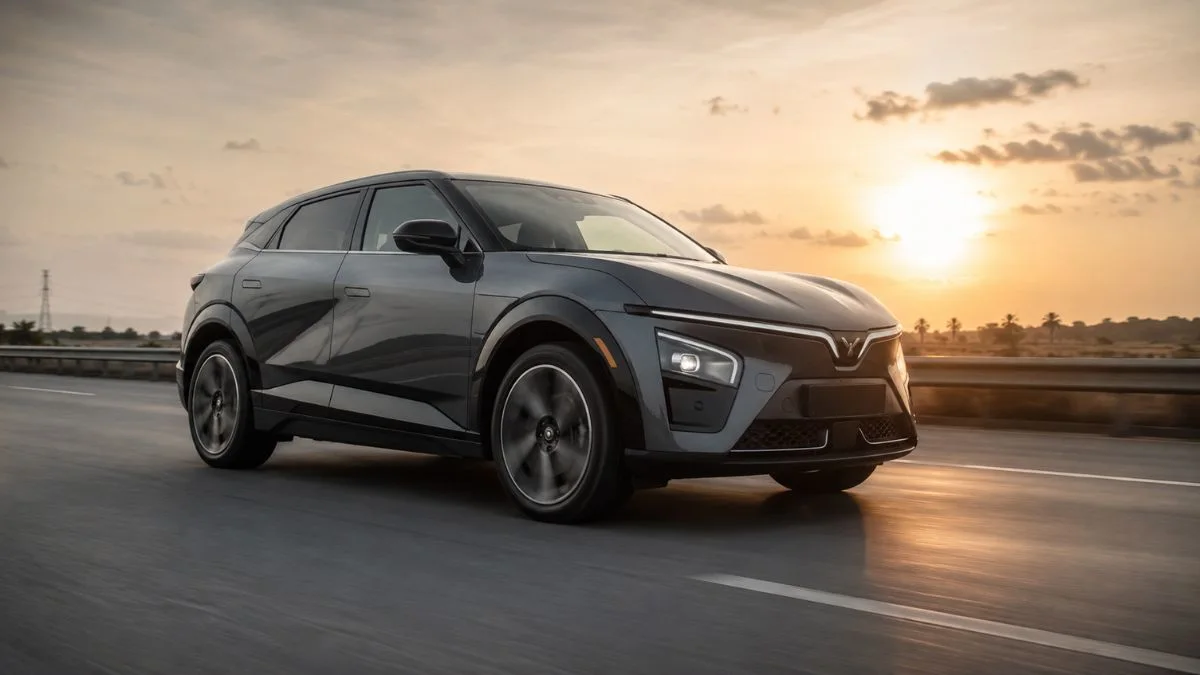
VinFast VF7 India Road Test Review: 350 HP AWD Under ₹27 Lakh, But At What Cost?
- The VinFast VF7 Sky AWD delivers 349 bhp and a 5.8-second 0–100 kph time for ₹26.79 lakh — performance figures that have no rival at this price in India.
- Indian buyers in the ₹20–30 lakh EV segment who want outright performance will find no faster option; those prioritising ergonomics, a known service network, or easy long-distance confidence should read this carefully first.
- Before booking, verify VinFast’s dealership and service presence in your city — the brand’s India after-sales network is still in its early stages.
Follow TrendPulse360 for real-time EV news, reviews, and buying guides.
| Spec | VF7 Earth (FWD) | VF7 Sky AWD |
|---|---|---|
| Price (ex-showroom) | ₹21.89 Lakh | ₹26.79 Lakh |
| Battery Capacity | 59.6 kWh | 70.8 kWh LFP |
| Motor Output | 174 bhp / 250 Nm | 349 bhp / 500 Nm |
| 0–100 kph | To be confirmed — check the manufacturer’s official announcement for the latest figures. | 5.8–6.03 seconds |
| ARAI Range | 438 km (certified) | 510 km (certified) |
| DC Fast Charging (10–70%) | To be confirmed — check the manufacturer’s official announcement for the latest figures. | ~24–28 min (100kW/110kW) |
| Safety Rating | 5-Star Bharat NCAP | 5-Star Bharat NCAP |
| Drivetrain | FWD (single motor) | AWD (dual motor) |
Verdict: A Performance Bargain With a Catch
The VinFast VF7 Sky AWD is the fastest electric SUV available in India under ₹27 lakh — and it isn’t particularly close. Based on road test data published by Autocar India, the dual-motor AWD variant hits 100 kph from a standstill in 5.8 seconds, a figure that puts several luxury EVs costing twice as much to shame.
But buying the VF7 in India today means accepting a set of real trade-offs: a cabin where nearly every function lives behind a 12.9-inch touchscreen, an ARAI-certified range that real-world conditions will reduce noticeably, and a brand that is still building its Indian service infrastructure from the ground up.
This review is written for buyers deciding between the VF7 and established rivals like the Tata Harrier EV and Mahindra BE 6. The answer depends entirely on what you value most.
Two Very Different Cars in One Lineup
The VF7 Earth (₹21.89 lakh, FWD, 59.6 kWh) and the VF7 Sky AWD (₹26.79 lakh, 70.8 kWh LFP) are not variations of the same car — they are two separate propositions.
The Earth trim’s 174 bhp FWD setup is a sensible urban commuter. The Sky AWD’s 349 bhp, 500 Nm dual-motor system is a performance machine that happens to be shaped like a crossover. Every performance figure in this review relates to the Sky AWD unless stated otherwise. Do not conflate the two when comparing prices.
Design: Unmistakable on Indian Roads
The VF7’s exterior design is polarising in a way that most Indian EVs are not. The crossover-inspired silhouette, with its low roofline and distinctive front DRL signature, stands apart from the upright SUV proportions of the Tata Harrier EV and the Mahindra BE 6.
Based on road test observations from Autocar India and Team-BHP, the VF7 reads as a premium product in traffic. The build quality, panel gaps, and paint finish are reported to be consistent with the car’s price positioning.
Interior and Technology: Premium Look, Frustrating Reality
The VF7’s cabin makes a strong first impression: vegan leather seating, a Head-Up Display, and a clean minimalist layout that signals premium intent. The Infinity trims add a panoramic glass roof that extends across most of the ceiling.
The problem is the 12.9-inch central touchscreen. Based on Autocar India and Team-BHP road test reports, virtually every secondary function — air conditioning temperature, fan speed, mirror adjustment — is controlled exclusively through this screen. There are no physical shortcut buttons for the most-used climate controls.
In Indian driving conditions — dense city traffic, chaotic junctions, constant lane changes — this design decision creates a genuine safety usability problem. Every AC adjustment requires the driver to look away from the road and navigate a touchscreen menu.
Rear-seat comfort is also noted as a limitation in early reviews. The high cabin floor, a consequence of the battery pack packaging, reduces under-thigh support for taller passengers on longer journeys.
Performance: The Number That Changes the Conversation
The VF7 Sky AWD’s 0–100 kph time of 5.8 to 6.03 seconds, sourced from Autocar India’s road test data and VinFast India’s official specifications, is the headline figure and it is legitimate.
For context, the Tata Harrier EV — the VF7’s most direct rival for Indian buyers — does not offer an AWD variant at any price. The Mahindra BE 6, which starts at approximately ₹18.90 lakh (verify current pricing at Mahindra’s official website before purchasing), offers strong performance on its born-EV platform but is not directly comparable in straight-line output. The BYD Atto 3, priced from approximately ₹24.99 lakh (verify at BYD India), does not offer an AWD option in this segment.
Under ₹27 lakh, the VF7 Sky AWD has no AWD rival in India. That is a significant competitive gap that VinFast has identified and filled.
Range: What the ARAI Figure Does Not Tell You
VinFast India’s official ARAI-certified range figures are 438 km for the 59.6 kWh Earth and 510 km for the 70.8 kWh AWD Sky variant. These are regulatory test cycle figures certified under MIDC/ARAI protocols and are accurate for what they measure.
Real-world range in Indian traffic and climate conditions will be lower. Based on early reviewer estimates from Autocar India and Team-BHP — not independently verified long-term data — the Sky AWD’s usable real-world range in mixed Indian conditions is estimated at approximately 375–420 km. This figure is a reviewer estimate, not an officially confirmed or independently tested result. Treat it as an indication, not a guarantee.
One ownership factor that affects real-world range specifically on the Infinity trim variants: the panoramic glass roof has no factory sunshade. In Indian summer conditions, this forces the air conditioning system to work significantly harder to maintain cabin temperature, with a measurable impact on battery consumption. This is a practical consideration that does not appear in ARAI range figures.
Charging: Fast When Infrastructure Cooperates
Based on VinFast India’s official specifications, the VF7 supports DC fast charging at 100kW/110kW, with a 10% to 70% charge taking approximately 24 to 28 minutes. This is a competitive charging speed for the segment.
The practical limitation is India’s public DC fast-charging infrastructure, which remains concentrated in major metros. For buyers outside Tier 1 cities, home charging via AC will be the primary method. VinFast India’s own charging network presence should be verified directly with the brand before purchase.
Safety: The VF7’s Strongest Credential
The VinFast VF7 has been awarded a 5-star rating by Bharat NCAP, India’s official vehicle safety assessment programme. This is a verifiable, independently tested result and one of the VF7’s strongest buying arguments.
The vehicle is equipped with 7 to 8 airbags and a Level 2 ADAS suite, based on specifications published by Autocar India and VinFast India. The full ADAS feature set for the India-spec variants should be confirmed against VinFast India’s official specification sheet, as ADAS configurations can vary by market.
The After-Sales Risk: What Early Adopter Reports Say
This is the section most first-drive reviews do not address directly, and it is the section that matters most for long-term ownership.
Early ownership threads on Team-BHP and Reddit — which are user-reported observations, not verified facts — include reports of delays in spare parts availability and limited technician familiarity with the platform at some VinFast service centres. These reports have not been independently confirmed and may not reflect the current or improving state of VinFast India’s service operations.
What is confirmed: VinFast entered India recently, and its dealer and service network is still in an early build-out phase compared to Tata Motors, Mahindra, or Hyundai. Buyers in cities where VinFast has an established service presence will face a different ownership experience than buyers in cities where the network is thin or absent. Check this directly with VinFast India before committing.
Analysis: What This Means for Indian EV Buyers
Analysis: The VinFast VF7 Sky AWD forces a question that the Indian EV market has not had to answer before at this price point: how much are you willing to pay in ownership convenience for outright performance?
Tata and Mahindra offer deeper service networks, more physical controls, and decades of brand familiarity. The VF7 Sky AWD offers 349 bhp, AWD, a 5-star safety rating, and a Level 2 ADAS suite for ₹26.79 lakh. No Indian or established global brand matches that performance specification at this price today.
The VF7 also applies pressure to the segment’s pricing structure. By delivering 5-star safety and AWD performance under ₹27 lakh, VinFast demonstrates that global EV economics can work in India at a performance-per-rupee ratio that established OEMs have not matched. If VinFast’s service network matures and real-world reliability proves consistent, the competitive implications for Tata and Mahindra’s premium EV pricing are significant.
For now, the VF7 is an early adopter’s car. The performance case is real. The ownership infrastructure case is still being built.
3 Things That Impress, 3 Things That Don’t
What works:
- AWD performance — 349 bhp, 500 Nm, 5.8 seconds — with no rival at this price in India
- 5-star Bharat NCAP rating with 7–8 airbags and Level 2 ADAS as standard on higher trims
- Premium cabin materials and distinctive exterior design that stand apart in the segment
What doesn’t:
- No physical AC or climate controls — every adjustment requires touchscreen interaction while driving
- No factory sunshade on the panoramic glass roof (Infinity trims) — a significant comfort and efficiency issue in the Indian summer
- Service network is nascent — parts availability and technician expertise are early-stage risks that buyers outside major metros must assess carefully
Who Should Buy the VinFast VF7 — and Who Should Not
The VF7 Sky AWD suits buyers who want maximum performance per rupee under ₹27 lakh, are based in a city with confirmed VinFast service presence, are comfortable with a learning curve on the touchscreen-heavy interface, and approach this as a considered early-adopter decision rather than a risk-free mainstream purchase.
The Tata Harrier EV or Mahindra BE 6 is the better choice for buyers who prioritise a known service network, want physical controls for daily climate use, or need confident long-distance range outside major metro corridors.
Quick Answer
- The VinFast VF7 Sky AWD delivers 349 bhp, a 5-star Bharat NCAP rating, and a 5.8-second 0–100 kph time for ₹26.79 lakh — the fastest AWD electric SUV available in India at this price.
- Its main weaknesses are a fully touchscreen-controlled cabin with no physical AC buttons, no sunshade on the panoramic roof, and an after-sales network that is still being established across India.
- Buy it if you are in a metro with confirmed VinFast service coverage and want performance above all else; choose the Tata Harrier EV or Mahindra BE 6 if service reliability and ergonomics matter more.
What is the real-world range of the VinFast VF7 in India?
The ARAI-certified range for the VF7 Sky AWD is 510 km on the 70.8 kWh LFP battery. Based on early reviewer estimates from Autocar India and Team-BHP — not independently verified data — real-world range in mixed Indian conditions is approximately 375–420 km for the AWD variant. This is a reviewer estimate, not a confirmed figure.
Is the VinFast VF7 faster than the Tata Harrier EV?
Yes, significantly. The VF7 Sky AWD completes 0–100 kph in 5.8–6.03 seconds, based on Autocar India’s road test data. The Tata Harrier EV does not offer an AWD variant. Verify the Harrier EV’s current 0–100 figure with Tata Motors directly for an exact comparison.
Does the VinFast VF7 have physical AC buttons?
No. Based on road test reports from Autocar India and Team-BHP, the VF7’s climate controls — including temperature, fan speed, and air direction — are controlled entirely through the 12.9-inch central touchscreen. There are no dedicated physical buttons for AC functions on the India-spec model.
Related Articles
- Tata Harrier EV 2026 Review: Is It Worth the Wait? (Review)
- Mahindra BE 6 Review: Does the Born-EV Platform Justify the Price? (Review)
- VinFast VF7 vs Tata Harrier EV vs Mahindra BE 6: Which Should You Buy? (Comparison)
- BYD Atto 3 vs VinFast VF7: Which Imported EV Wins in India? (Comparison)
- Best Electric SUVs in India Under ₹30 Lakh: 2026 Ultimate Buying Guide (Buying Guide)
For official specifications and current pricing, verify directly at VinFast India’s official website. For independent safety ratings, refer to the Bharat NCAP official results.
Verification Note: Key performance figures (349 bhp, 500 Nm, 5.8-second 0–100 kph) are sourced from Autocar India’s road test and VinFast India’s official specifications page. ARAI range certifications (438 km / 510 km) are based on regulatory MIDC test cycle data. Competitor pricing for the Tata Harrier EV, Mahindra BE 6, and BYD Atto 3 should be verified against each manufacturer’s official India website before making a purchase decision, as prices are subject to change

Chetan Patil is the Founder, Editor & Publisher of TrendPulse360, covering automotive news, EV technology, and mobility trends. With over five years of experience researching automotive markets and digital publishing, he focuses on accurate, reader-first coverage of vehicle launches, reviews, and buying guides, and oversees editorial standards and fact-checking across the site.